

Optical Transceivers Market to Reach US$46.5 Billion by 2033, Growing at a CAGR of 14.7% from 2026
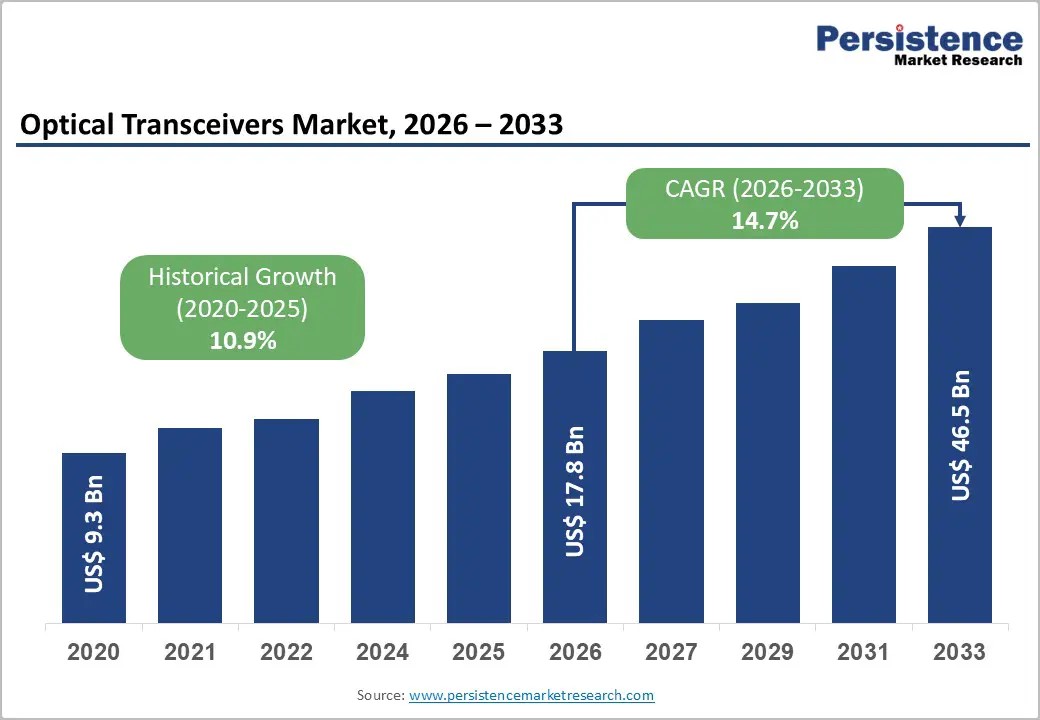
The Optical Transceivers Market is set to reach US$ 46.5Bn by 2033, growing at a 14.7% CAGR, driven by demand for high-speed data and cloud centers
BRENTFORD, ENGLAND, UNITED KINGDOM, June 4, 2026 /EINPresswire.com/ -- The global optical transceivers market is witnessing remarkable expansion as enterprises, telecom operators, and cloud service providers continue investing in high-speed networking infrastructure. Optical transceivers are essential components that convert electrical signals into optical signals and vice versa, enabling efficient data transmission across fiber-optic networks. According to market estimates, the global optical transceivers market size is projected to increase from US$ 17.8 billion in 2026 to US$ 46.5 billion by 2033, registering an impressive CAGR of 14.7% during the forecast period from 2026 to 2033. The growing demand for bandwidth-intensive applications, cloud computing, artificial intelligence (AI), machine learning, video streaming, and next-generation communication networks is significantly accelerating market growth. As global internet traffic continues to surge, organizations are increasingly adopting advanced optical networking technologies to maintain reliable and high-capacity connectivity.
One of the primary drivers behind the market's growth is the rapid expansion of hyperscale data centers and the widespread deployment of 5G infrastructure worldwide. Data centers represent the leading application segment, accounting for more than 52% of the global market share in 2026, owing to their dependence on ultra-fast, low-latency optical interconnects for cloud services, AI workloads, and big data analytics. In terms of form factors, SFP, SFP+, and SFP28 transceivers dominate the market with over 46% share, supported by their cost-effectiveness, flexibility, and compatibility across networking environments. Geographically, Asia Pacific leads the global optical transceivers market with more than 38% market share in 2026, driven by China's aggressive 5G deployment, growing telecom infrastructure, increasing investments in hyperscale data centers, and the region's strong manufacturing ecosystem for optical networking components.
𝐆𝐞𝐭 𝐚 𝐒𝐚𝐦𝐩𝐥𝐞 𝐏𝐃𝐅 𝐁𝐫𝐨𝐜𝐡𝐮𝐫𝐞 𝐨𝐟 𝐭𝐡𝐞 𝐑𝐞𝐩𝐨𝐫𝐭: https://www.persistencemarketresearch.com/samples/4798
Market Segmentation Analysis
The optical transceivers market is segmented by form factor, transmission rate, and application. By form factor, SFP, SFP+, and SFP28 dominate the market due to their cost-effectiveness, compact design, and broad compatibility across enterprise and telecom networks. Meanwhile, QSFP, QSFP+, QSFP28, and QSFP-DD are the fastest-growing segments as they support higher bandwidth, greater port density, and improved energy efficiency for modern networking environments.
Based on transmission rate, the 100G–400G segment holds the largest market share owing to its balance of performance, scalability, and efficiency. However, the 400G–800G segment is witnessing the fastest growth, driven by increasing demand from AI workloads, cloud computing, and high-performance data center applications.
By application, data centers account for the largest share of the market due to growing cloud computing, AI, and big data processing requirements. The telecom segment is expected to expand at the fastest pace, supported by global 5G deployment and ongoing fiber-optic network upgrades.
Regional Insights
Asia Pacific leads the optical transceivers market, driven by rapid 5G expansion, strong telecom infrastructure investments, and growing data center construction across China, Japan, South Korea, and Southeast Asia. The region also benefits from its position as a major manufacturing hub for optical components.
North America remains a key market due to the presence of hyperscale data centers, major cloud service providers, and increasing investments in AI and broadband infrastructure. Europe continues to grow steadily with rising digital transformation initiatives, fiber deployments, and coordinated 5G rollouts across major economies.
Latin America and the Middle East & Africa are emerging markets, supported by increasing broadband penetration, telecom modernization projects, and growing demand for high-speed connectivity.
𝐃𝐨 𝐘𝐨𝐮 𝐇𝐚𝐯𝐞 𝐀𝐧𝐲 𝐐𝐮𝐞𝐫𝐲 𝐎𝐫 𝐒𝐩𝐞𝐜𝐢𝐟𝐢𝐜 𝐑𝐞𝐪𝐮𝐢𝐫𝐞𝐦𝐞𝐧𝐭? 𝐑𝐞𝐪𝐮𝐞𝐬𝐭 𝐂𝐮𝐬𝐭𝐨𝐦𝐢𝐳𝐚𝐭𝐢𝐨𝐧 𝐨𝐟 𝐑𝐞𝐩𝐨𝐫𝐭: https://www.persistencemarketresearch.com/request-customization/4798
Market Drivers
The rapid expansion of hyperscale data centers, cloud computing, and AI applications is a major driver of the optical transceivers market. Growing data traffic and the need for low-latency, high-speed connectivity are accelerating the adoption of advanced optical networking solutions. Additionally, the global rollout of 5G networks is increasing demand for high-capacity optical transceivers across telecom infrastructure.
Market Restraints
High manufacturing costs remain a key challenge, particularly for advanced 400G and 800G transceivers that require sophisticated photonic components and precision production processes. Supply chain disruptions and shortages of specialized semiconductor materials further impact production and increase costs. Interoperability challenges across different form factors and standards also slow adoption in some network environments.
Market Opportunities
Emerging technologies such as Co-Packaged Optics (CPO) offer significant growth opportunities by enabling higher bandwidth, lower power consumption, and greater network efficiency. Rising investments in AI infrastructure, fiber-to-the-home (FTTH) deployments, and next-generation telecom networks are also creating strong demand for advanced optical transceivers. Furthermore, innovations in compact and high-density form factors are opening new avenues for market expansion.
Company Insights
Key Players Operating in the Optical Transceivers Market
• Cisco Systems, Inc.
• Coherent Corp.
• Broadcom Inc.
• Lumentum Holdings Inc.
• Sumitomo Electric Industries Ltd.
• InnoLight Technology
• Accelink Technologies Co., Ltd.
• NeoPhotonics Corporation
• Fujitsu Optical Components Ltd.
• ATOP Technologies Co., Ltd.
• Huawei Technologies Co., Ltd.
• Other Regional and Global Players
𝐁𝐮𝐲 𝐍𝐨𝐰 𝐭𝐡𝐞 𝐃𝐞𝐭𝐚𝐢𝐥𝐞𝐝 𝐑𝐞𝐩𝐨𝐫𝐭: https://www.persistencemarketresearch.com/checkout/4798
Conclusion
The optical transceivers market is positioned for substantial growth as global demand for high-speed, low-latency, and energy-efficient data transmission continues to increase. The rapid expansion of hyperscale data centers, widespread adoption of artificial intelligence, deployment of 5G networks, and ongoing digital transformation initiatives are creating strong demand for advanced optical networking solutions. While challenges such as manufacturing costs, supply chain constraints, and interoperability complexities remain, continuous technological innovation is enabling new growth opportunities. Advancements in co-packaged optics, 400G and 800G connectivity, and next-generation form factors are expected to redefine industry standards and support future network scalability. With Asia Pacific maintaining market leadership and global investments in digital infrastructure accelerating, the optical transceivers market is expected to remain a critical component of the evolving telecommunications and data communications ecosystem through 2033.
Related Reports:
Caesium and Hydrogen Maser Atomic Clock Market
Pooja Gawai
Persistence Market Research
+1 646-878-6329
email us here
Visit us on social media:
LinkedIn
Instagram
Facebook
YouTube
X
Legal Disclaimer:
EIN Presswire provides this news content "as is" without warranty of any kind. We do not accept any responsibility or liability for the accuracy, content, images, videos, licenses, completeness, legality, or reliability of the information contained in this article. If you have any complaints or copyright issues related to this article, kindly contact the author above.
