
Compact ionospheric model enables faster multi-GNSS positioning
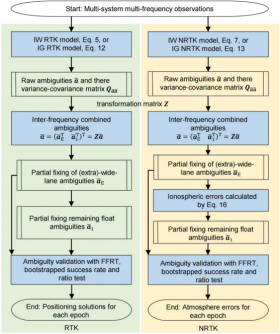
IAR strategy for RTK positioning (left) and NRTK server (right).
FAYETTEVILLE, GA, UNITED STATES, July 25, 2026 /EINPresswire.com/ -- A new way to model ionospheric delay could help multi-GNSS real-time kinematic (RTK) and network RTK (NRTK) systems reach reliable centimeter-level solutions more quickly over medium-to-long baselines. Instead of estimating a separate ionospheric delay for every satellite pair, the method uses a compact gradient representation of regional ionospheric variation shared across all tracked satellites. By reducing the number of unknown parameters while retaining ionospheric correction, the method strengthens ambiguity estimation and supports earlier reliable fixing. Tests with data from low- and mid-latitude reference stations showed faster initialization, higher ambiguity-fixing success rates, and consistent improvements in three-dimensional positioning accuracy.
RTK and NRTK positioning combine code and carrier-phase measurements from multiple Global Navigation Satellite System (GNSS) constellations. A critical step is integer ambiguity resolution (IAR), which determines the whole-number carrier-phase cycles required for centimeter-level positioning. Over baselines longer than about 30 kilometers, residual ionospheric delay can slow this process. Conventional ionosphere-weighted (IW) models estimate one double-differenced (DD) slant ionospheric parameter for each satellite pair. As more constellations and frequencies are added, this satellite-pair-specific approach introduces too many unknowns, weakening the functional model and degrading ambiguity resolution. The challenge is therefore to preserve effective ionospheric mitigation while reducing the parameter burden.
Researchers from the College of Surveying and GeoInformatics at Tongji University published (DOI: 10.1186/s43020-026-00207-x) the study on July 15, 2026, in Satellite Navigation. The team proposed an ionospheric gradient (IG) model that represents DD ionospheric delays using a compact set of coefficients linked to ionospheric pierce points (IPPs), the points at which satellite signal paths intersect a simplified ionospheric shell. The coefficients are estimated jointly with carrier-phase ambiguities, tropospheric delays, and other positioning parameters, allowing all tracked satellites to contribute to a common description of regional ionospheric variation rather than being modeled independently by satellite pair.
In the second-order implementation evaluated in the study, horizontal changes in vertical total electron content (VTEC) are described with six coefficients per epoch. In a representative case with 16 satellites from two constellations, this reduced the number of ionospheric parameters from 14 to six, a reduction of about 57%. The researchers evaluated the method using multi-frequency observations from 10 stations in low- and mid-latitude regions collected from May 1 to May 8, 2025. Solar activity was stable and geomagnetic activity was predominantly low to moderate during the test period. A Kalman filter jointly estimated the IG coefficients and positioning parameters, while repeated two-hour reinitialization tests compared the IG and IW models. The IG model represented DD ionospheric delays with elevation-dependent residuals. Residuals are generally larger for low-elevation satellites, while the average standard deviation remained below four centimeters. In NRTK processing, narrow-lane float-ambiguity precision improved by 12.1%, average convergence time decreased from 26.4 to 9.9 seconds, and the ambiguity-fixing success rate increased from 95.6% to 98.2%. In RTK tests, average time to first fix (TTFF) decreased from 10.4 to 7.4 seconds, and the fixing success rate increased from 96.2% to 98.6%. Root mean square (RMS) positioning errors in the north, east, and up directions improved from 2.8, 3.2, and 4.3 centimeters to 2.4, 2.8, and 3.9 centimeters, respectively.
The authors said the model's main advantage is that it allows all visible satellites to contribute to one physically interpretable representation of regional ionospheric variation, rather than adding a new ionospheric unknown for each satellite pair. This stronger formulation improves float-ambiguity precision and enables reliable fixing sooner while retaining the dominant spatial behavior of the ionosphere. The method is not intended as a universal replacement for more flexible models: severe, localized, or highly nonlinear disturbances may leave larger residual errors, particularly in sparse networks or for low-elevation satellites. Under such conditions, adaptive modeling and further validation will be needed.
For NRTK service providers, the approach could reduce the number of ionospheric parameters that must be estimated and broadcast while enabling faster and more reliable network initialization. Faster ambiguity fixing may benefit real-time centimeter-level applications such as engineering surveying, deformation monitoring, precision agriculture, construction automation, and navigation for connected or autonomous platforms. The compact model may also make multi-constellation processing easier to scale as more satellites and frequencies become available. Future work will test the method during stronger space-weather events and assess how reference-station density and geometry affect performance, helping to define the conditions under which the IG model provides the best balance of efficiency, accuracy, and robustness.
References
DOI
10.1186/s43020-026-00207-x
Original Source URL
https://doi.org/10.1186/s43020-026-00207-x
Funding Information
The National Natural Science Funds of China (42225401, 42504031 and 42430109), Fundamental and Interdisciplinary Disciplines Breakthrough Plan of the Ministry of Education of China (JYB2025XDXM111), the Yangtze River Delta Technology Innovation Community Joint Research Program (2025CSJZN01900), the China Postdoctoral Science Foundation under Grant Number 2025M780216, and the industrial Collaborative Innovation Project (Technology) of Shanghai Municipality (XTCX-KJ-2024-03).
Lucy Wang
BioDesign Research
email us here
Legal Disclaimer:
EIN Presswire provides this news content "as is" without warranty of any kind. We do not accept any responsibility or liability for the accuracy, content, images, videos, licenses, completeness, legality, or reliability of the information contained in this article. If you have any complaints or copyright issues related to this article, kindly contact the author above.
