

Automotive Radar Applications Market to Reach USD 30.75 Billion by 2035, Growing at 21.53% CAGR
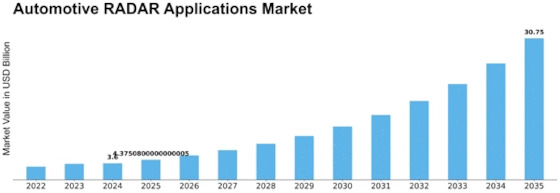
Automotive Radar Applications Market
Growth in autonomous driving technologies is particularly pronounced in the Asia-Pacific region, recognized as the fastest-growing market.
NEW YORK, NY, UNITED STATES, September 3, 2026 /EINPresswire.com/ -- According to Market Research Future, the Automotive Radar Applications Market is projected to reach USD 30.75 Billion by 2035, registering a CAGR of 21.53% during the forecast period . This exceptional growth reflects the central role of radar technology in the automotive industry's transformation toward greater safety, automation, and intelligence, where radar applications have become indispensable sensors for enabling advanced driver assistance systems and autonomous driving capabilities. The Advanced Driver Assistance Systems Market is closely intertwined with radar development, as radar sensors constitute the primary perception technology for many ADAS functions, while the Automotive Safety System Market continues to expand alongside the broader vehicle safety ecosystem.Market Overview
Automotive radar applications represent the use of radio detection and ranging technology in vehicles to detect objects, measure distances, and monitor surroundings for enhanced safety and driving assistance. These systems operate across various frequency bands—including 24 GHz, 77 GHz, and 79 GHz—to support critical functions such as adaptive cruise control, blind spot detection, forward collision warning, lane departure warning, and parking assistance . Unlike cameras and LiDAR, radar offers unique advantages in adverse weather conditions, providing reliable object detection in rain, fog, and darkness that makes it an indispensable component of modern vehicle sensor suites.
The key growth drivers propelling this market expansion include the escalating global emphasis on vehicle safety, with governments and regulatory bodies worldwide mandating advanced safety features and pushing for accident reduction and enhanced road safety. Radar applications play a pivotal role in meeting these stringent safety standards through enabling collision avoidance, adaptive cruise control, and other critical functions . The widespread adoption of advanced driver assistance systems (ADAS) is another primary driver, as ADAS relies heavily on radar technology for lane-keeping assistance, automatic emergency braking, and blind-spot detection. As consumers increasingly demand these features, demand for radar applications continues to surge . The growing trend toward autonomous vehicles further accelerates market expansion, as autonomous vehicles depend on radar sensors for real-time detection of obstacles, pedestrians, and other vehicles, contributing to vehicle decision-making processes .
Technological developments are reshaping the radar applications landscape at an accelerating pace. The transition toward higher frequency bands, particularly 77 GHz and 79 GHz, has been a defining trend, with 77 GHz now representing the largest segment with approximately 60% market share due to its superior performance in resolution and detection range . 79 GHz radar represents the latest frontier in automotive radar technology, offering even higher resolution and precision for high-level autonomous driving scenarios requiring extremely accurate object detection and localization . The shift from traditional mechanically scanned radar systems to solid-state radar offers advantages including smaller form factors, lower power consumption, and increased reliability . Sensor fusion, where radar is integrated with other sensing technologies such as LiDAR and cameras, is enhancing the overall perception capabilities of vehicles, providing a more comprehensive view of the surrounding environment . Short-range radar systems are gaining popularity for parking assistance and collision avoidance at low speeds, becoming more sophisticated in aiding drivers through tight spaces .
Market Segmentation
The automotive radar applications market is segmented based on frequency, application, and technology to provide comprehensive insights into the industry landscape.
By Frequency: The market is categorized into 24 GHz, 77 GHz, and 79 GHz segments. The 24 GHz segment has been a longstanding player in automotive applications, providing a balance between cost-effectiveness and functionality for entry-level and mid-range vehicles. While limitations in resolution exist compared to higher frequencies, these systems remain essential where moderate performance is sufficient . The 77 GHz segment has witnessed significant growth and adoption, becoming a standard in many advanced driver assistance systems and autonomous driving applications. This frequency range provides higher resolution and accuracy, making it suitable for sophisticated safety features such as automatic emergency braking, blind-spot detection, and lane-keeping assistance . The 79 GHz segment represents the latest frontier in automotive radar technology, offering even higher resolution and precision for applications demanding extremely accurate object detection and localization, such as high-level autonomous driving scenarios . The automotive industry's shift toward higher autonomy levels has been a key driver for the increased use of 77 GHz and 79 GHz radar systems .
By Application: The market serves Adaptive Cruise Control, Blind Spot Detection, Forward Collision Warning System, Lane Departure Warning System, and Parking Assistance applications. Adaptive cruise control is projected to be the fastest-growing application segment, driven by increasing consumer demand for convenience features and the growing adoption of semi-autonomous driving technologies .
By Technology: The market covers LiDAR, Millimeter-Wave Radar, Camera, and Ultrasonic Radar technologies. Millimeter-wave radar represents the dominant technology segment, offering superior performance in adverse weather conditions and longer detection ranges compared to alternative sensor technologies .
By Region: The market analysis covers North America, Europe, South America, Asia Pacific, and the Middle East and Africa, providing comprehensive geographic insights into regional dynamics and growth opportunities .
🛒 You can buy this market report at:
https://www.marketresearchfuture.com/checkout?currency=one_user-USD&report_id=2563
Regional Analysis
North America is projected to be the largest regional market for automotive radar applications, driven by stringent vehicle safety regulations, high consumer demand for advanced safety features, and the presence of leading automotive and technology companies . The United States market is at the forefront of ADAS and autonomous vehicle development, with substantial investments in radar technology innovation and deployment. Early adoption of 77 GHz and 79 GHz radar systems in premium and mid-range vehicles, supported by strong regulatory frameworks and safety standards, reinforces the region's market leadership.
Europe represents another significant and technologically advanced market, shaped by the European Union's strict vehicle safety regulations and the region's strong automotive engineering heritage. The European New Car Assessment Programme has been instrumental in driving the adoption of advanced safety features requiring radar technology . Germany, France, Italy, and the United Kingdom are key contributors, with German automakers leading in the integration of radar-based ADAS and autonomous driving technologies. The region's safety-conscious consumer base, combined with supportive regulatory frameworks and extensive R&D investments, supports the region's growth.
Asia Pacific is poised to witness substantial growth, driven by the region's massive automotive production base, rapid vehicle electrification, and increasing demand for advanced safety features. China, the world's largest automotive market, is at the forefront of radar adoption in new energy vehicles, with domestic automakers integrating radar-based ADAS as standard across an expanding model range . Japan and South Korea drive radar technology innovation and autonomous driving development, while India is emerging as a growth market for radar-based safety features as vehicle safety awareness and regulatory requirements increase.
South America and the Middle East and Africa represent developing markets with growing potential, where increasing vehicle ownership and improving economic conditions are driving gradual adoption of radar-based safety features.
Competitive Landscape and Key Players
The automotive radar applications market is highly competitive, featuring a mix of established semiconductor manufacturers, automotive suppliers, and technology innovators. The competitive landscape is characterized by technological innovation, strategic partnerships, and continuous investment in next-generation radar solutions.
Key players operating in this market include Robert Bosch GmbH, Continental AG, DENSO Corporation, ZF Friedrichshafen AG, Aptiv PLC, Texas Instruments Inc., HELLA GmbH & Co. KGaA, NXP Semiconductors N.V., Infineon Technologies AG, and Analog Devices Inc. . These industry leaders are investing heavily in research and development to create advanced radar solutions that support higher frequencies, improved resolution, and integration with other sensor technologies.
Strategic developments are reshaping the competitive landscape. Leading suppliers are extending beyond component manufacturing into sensor fusion solutions and autonomous driving platforms that combine radar with other perception technologies . The shift toward 77 GHz and 79 GHz radar systems is driving substantial R&D investment in higher-frequency technologies that enable precision in critical safety applications . Companies are also focusing on sensor fusion capabilities and integration with ADAS and autonomous driving ecosystems to offer comprehensive solutions.
Innovation and technology initiatives are accelerating across the industry. Firms are investing in solid-state radar solutions that offer smaller form factors, lower power consumption, and increased reliability, contributing to the overall integration of radar into modern vehicles . The development of radar systems optimized for harsh weather conditions, including heavy rain, snow, and fog, is enhancing reliability and performance . The integration of radar with vehicle-to-vehicle and vehicle-to-infrastructure communication systems is improving overall road safety and traffic efficiency .
Latest Industry News and Developments
Recent industry developments highlight the dynamic nature of the automotive radar applications market. Major players continue to expand their radar portfolios through new product launches and strategic partnerships. The growing adoption of 77 GHz radar systems, now representing approximately 60% market share, has become the industry standard for advanced driver assistance systems and autonomous driving applications . This shift toward higher frequency bands allows for higher resolution and improved performance in various driving conditions, contributing to enhanced safety features .
Sensor fusion is emerging as a key trend, where radar is being integrated with LiDAR and cameras to enhance the overall perception capabilities of vehicles, providing a more comprehensive view of the surrounding environment and enabling higher levels of autonomy . Short-range radar systems are becoming more sophisticated for parking assistance and collision avoidance at low speeds, while solid-state radar technologies are gaining traction for their smaller form factors and increased reliability .
Market Challenges and Opportunities
The automotive radar applications market faces several key challenges that could impact growth trajectories. Sensor fusion complexity, involving the integration of multiple radar sensors with other sensor modalities including cameras and LiDAR, presents significant technical challenges and substantial cost implications that directly increase overall vehicle development and manufacturing costs . Consumer education and acceptance of radar-based safety features is essential for adoption, as misunderstandings or lack of awareness about radar technology can lead to skepticism and resistance . Ensuring long-term reliability and maintenance of radar systems is crucial for vehicle safety, developing systems that can withstand the rigors of everyday use and require minimal maintenance .
Emerging opportunities are abundant in the evolving mobility landscape. The increasing vehicle connectivity and communication enables radar-equipped vehicles to communicate with each other and infrastructure, improving road safety and traffic efficiency . The expansion of autonomous vehicle development creates significant demand for radar sensors capable of providing reliable perception across diverse operating conditions. The growing adoption of 77 GHz and 79 GHz radar systems for enhanced resolution and performance creates opportunities for suppliers specializing in higher-frequency technologies . The emergence of solid-state radar technologies offers opportunities for smaller, more reliable radar solutions .
To explore more market insights, visit us at:
https://www.marketresearchfuture.com/reports/automotive-radar-applications-market-2563
Final Market Summary
The automotive radar applications market is poised for exceptional growth, driven by regulatory safety mandates, the proliferation of advanced driver assistance systems, and the accelerating transition toward autonomous vehicles. The market's trajectory to USD 30.75 Billion by 2035 reflects the central role of radar technology in enabling safer, smarter, and more autonomous vehicles.
The long-term industry potential remains exceptionally bright, with advancements in higher-frequency radar systems, solid-state technologies, and sensor fusion continuing to expand the capabilities and applications of automotive radar. The convergence of radar with broader vehicle electronics, including connected vehicle systems, autonomous driving platforms, and ADAS ecosystems, is creating comprehensive solutions that serve diverse vehicle needs across passenger and commercial segments.
Key factors expected to influence future development include the pace of autonomous driving adoption, the evolution of safety regulations, and the advancement of higher-frequency radar technologies. The development of affordable, high-performance radar solutions and sensor fusion platforms will accelerate adoption across broader vehicle segments. As vehicles become increasingly connected, autonomous, and software-defined, the role of radar applications will continue to expand, ensuring sustained innovation and growth throughout the forecast period and beyond.
More Related Reports from MRFR Library:
Transfer Case Market : https://www.marketresearchfuture.com/reports/transfer-case-market-5088
Hybrid System in Automotive Market : https://www.marketresearchfuture.com/reports/hybrid-system-automotive-market-5100
Automotive Night Vision System Market : https://www.marketresearchfuture.com/reports/automotive-night-vision-system-market-5124
Automotive Voice Recognition System Market : https://www.marketresearchfuture.com/reports/automotive-voice-recognition-system-market-5154
Automotive Chassis Market : https://www.marketresearchfuture.com/reports/automotive-chassis-market-5183
E Scooters Market : https://www.marketresearchfuture.com/reports/e-scooters-market-5209
Smart Fleet Management Market : https://www.marketresearchfuture.com/reports/smart-fleet-management-market-5226
Automotive Instrument Cluster Market : https://www.marketresearchfuture.com/reports/automotive-instrument-cluster-market-5241
Automotive Structural Sheet Market : https://www.marketresearchfuture.com/reports/automotive-structural-sheet-market-5288
Selective Catalytic Reduction Market : https://www.marketresearchfuture.com/reports/selective-catalytic-reduction-market-5324
Market Research Future
Market Research Future
+1 855-661-4441
email us here
Legal Disclaimer:
EIN Presswire provides this news content "as is" without warranty of any kind. We do not accept any responsibility or liability for the accuracy, content, images, videos, licenses, completeness, legality, or reliability of the information contained in this article. If you have any complaints or copyright issues related to this article, kindly contact the author above.
